Kęstutis escapes Marienburg
What the chronicles say [Historical record]
The captured prisoner who walked out of the Order’s capital is one of the better-attested episodes of the century. Kęstutis, over sixty, and Algirdas had taken Eckersberg and Johannisburg; a small band of knights returning from another raid fell on his camp by Lake Ublik (Wobel) in Masuria. Wigand dates the capture 21 March 1361 (Wartberge: 13 March). He was held at Marienburg about half a year and escaped on 11 November 1361 (Baronas: around 11 or 17–18 November) with the help of Alfas (Adolfas), a servant of Lithuanian origin, who removed bricks from the cell wall over months and carried out the rubble; Kęstutis broke through the wall, crossed the empty terrace, dropped into the dry moat where Alfas waited with horses and a Teutonic knight’s cloak, and rode out through the outer gate as a knight, toward Liebstadt; he hid in a bog, freed the horses and went on foot over the Drwęca to Mazovia. Alfas’s fate is not recorded. The main source is Wigand of Marburg, whose chronicle survives only through a Latin translation and fragments; Baronas (2004) notes that Wigand knew details only a participant could. See Baronas, “Kęstučio pabėgimas iš Marienburgo” (Lietuvos istorijos studijos), and Wikipedia, Kęstutis.
Kęstutis escapes Marienburg
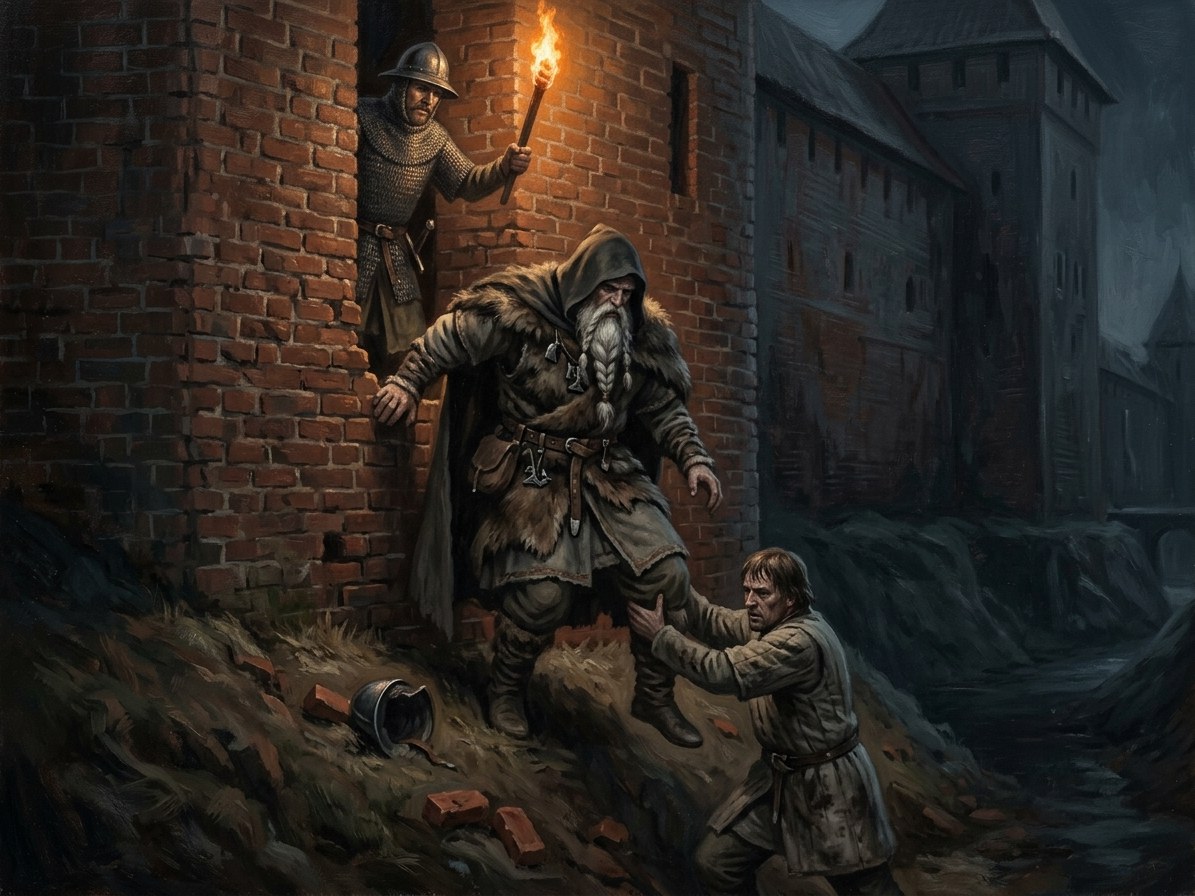
Kęstutis escapes Marienburg · event
Type |
event |
Years |
1361-11-11 |
Status |
Historical record |
Book |
|
Note |
Alf (Adolfas) removed bricks over months; Kęstutis broke through the wall, dropped into the dry moat, rode out as a knight; on foot over the Drwęca to Mazovia. Capture: Lake Ublik, March 1361. |
Where: Marienburg (Malbork) (on the map)
What really happened [The saga’s invention]
No magic. In the consecrated cellars Birutė’s amber bead goes cold (Kalba cannot reach into a consecrated place) and the Order lets him keep it. The escape is wit and loyalty: Kniprode, Grand Master for nearly ten years, offers freedom for baptism and Kęstutis, bound by his thunder-mark, cannot promise what he will not keep. The invented young brother Hohenstein (the third knight who took him at Ublik; not the real Osterode komtur) carries his meals and translates; the young wolf Jonas, taken in the same column, kills a sergeant at the last gate and takes his Christian name (saga). Alfas’s fate is left open. It becomes the template for his son’s escape in 1382.
Consequences
Caused by the capture at Lake Ublik. The escape is the pattern Vytautas repeats at Krėva twenty-one years later (Kęstutis tells it to him at Krėva, Book I ch. 8).
Dramatisation
Book VI ch. 16 “Paimtas” (Kęstutis; March 1361, Lake Ublik), ch. 17 “Marienburgo Požemis” (Kniprode; September), ch. 18 “Alfo Raktas” (Jonas; 11 November 1361, the eve of the saga’s Vėlinės mood). Told again by Kęstutis to Vytautas in Book I ch. 8 (the wall dug out, the white knight’s mantle, the horses).
Relations
Caused by: Kęstutis captured at Lake Ublik
Location: Marienburg (Malbork)
Participants: Kęstutis
Connections
graph LR
  ev_kestutis_captured_1361["Kęstutis captured at Lake Ublik"]
  ev_kestutis_escape_1361["Kęstutis escapes Marienburg"]
  kestutis["Kęstutis"]
  marienburg["Marienburg (Malbork)"]
  ev_kestutis_escape_1361 -->|Location| marienburg
  kestutis -->|Took part in| ev_kestutis_escape_1361
  ev_kestutis_captured_1361 -->|Causes| ev_kestutis_escape_1361
  style ev_kestutis_escape_1361 stroke-width:3px