Laima¶
Folk sources [Historical record]¶
Laima decides each person’s fate at birth (Laima lėmė, “Laima decreed”), and she appears in songs at births and weddings. The earliest written name is “Laimelea” in Wilhelm Martini’s Latin preface to Daniel Klein’s Lithuanian songs (1666); Prätorius and later 17th–18th-century writers follow. Latvian Laima has two sisters, Kārta and Dēkla. Nineteenth-century birth rites, performed by women in the bathhouse (pirtis), offered her a hen, linen or towels. The cuckoo is her bird in later folklore.
Contested: Lithuanian Laima is sometimes one goddess and sometimes three, and she is often confused with laimė (“luck”) and laumė (“fairy”). Dalia (“share”) and Giltinė as Laima’s sisters, and the seven spinning deivės valdytojos (Gimbutas’s reconstruction), are largely folk or modern. Greimas argued that Laima knows fate rather than imposes it, against the old label of a “fatalistic” religion.
In the saga¶
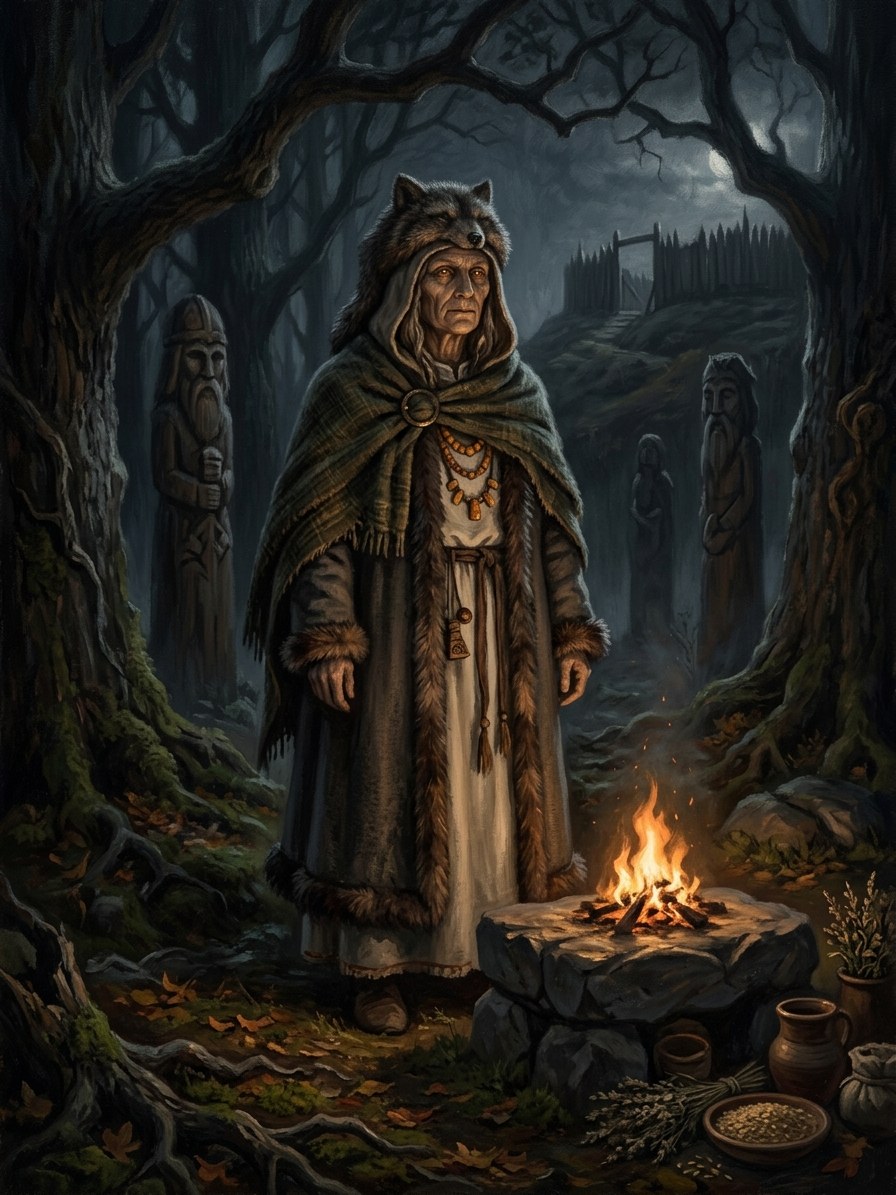
Domain: fate, share, death. Element: none. Force-face: none. She spins every thread at birth; Dalia measures it and Giltinė cuts it (Cosmology §3.1, bestiary). Laima’s spinning is why seers see possibilities, never certainties, and she is patron of Užkalbėjimai and of Stars (Praurimė reads her threads).
Her scene is Book VI ch. 12 (“Laima prie Lopšio”): at Vytautas’s birth (1350), three women come to Birutė’s lamplit room, a spinner who says “we are not gods; we only read the thread”, a merry younger sister, and a tall grey one with sheep-shears. They foretell three baptisms, a crown that will follow him all his life, and that he will outlive his heirs. Birutė stops the shears with the word “Dar ne” (“not yet”). Laima warns that “not yet” is paid for, and Birutė answers “I will pay”: the first sign of her surety. Book I ch. 3’s vision, “a possibility, not a doom”, is the same law. Weakness: she keeps her ledger to the letter, yet a thread can be asked to be re-tied, and every re-tying shortens another.
Offerings & taboos¶
Linen, a towel or a hen left for her in the bathhouse at a birth, women only. Fates spun without a gift are plainer after 1387, with fewer surprises.
Pronunciation¶
LYE-mah (IPA [ˈɫɐɪmɐ]). Sisters: DAH-lyah (Dalia), gil-TIH-nay (Giltinė).
Relations
Patron of: Užkalbėjimai (charms) · Žvaigždės (Stars) — Laima’s spinning is what Praurimė’s sight reads.
Servants: Giltinė — Sister who cuts the thread.
Domain Fate, share, death (with Dalia and Giltinė)
Layer God (Layer I) · no Force-face
Force-face None
Offerings Linen, a towel or a hen left for her in the pirtis at a birth, women only
Taboos Naming the third sister in a house with a newborn; keeping her out (the shutters are left open on the first night)
Signs Three grey women at the edge of lamplight at a birth, spinning, measuring, shears in a lap; a cuckoo calling in winter
The thread. She spins every fate at birth, Dalia measures it, Giltinė cuts it. Her spinning is why seers see possibilities, never certainties.
Re-tying. A born seer at the winter-solstice midnight may ask the deivės to re-tie a thread.
Patronage. Patron of Užkalbėjimai and of the Stars working.
A wall. Her decree is a sentence, not a wall: the words are fixed, their meaning is open. She keeps her ledger to the letter.
Gifts withheld. After 1387, fates spun without a gift are plainer, with fewer surprises.
Every re-tying. Shortens another life somewhere, by as much.
Not yet. A mother may speak one word on the first night, and Laima warns it is paid for. Birutė's surety is that bill (Book VI ch. 12).
Connections¶
graph LR
  el_stars["Žvaigždės (Stars)"]
  giltine["Giltinė"]
  laima["Laima"]
  uzkalbejimai["Užkalbėjimai (charms)"]
  laima -->|Patron of| el_stars
  laima -->|Patron of| uzkalbejimai
  giltine -->|Servant of| laima
  style laima stroke-width:3px