Žolės (herb-lore)
What it is
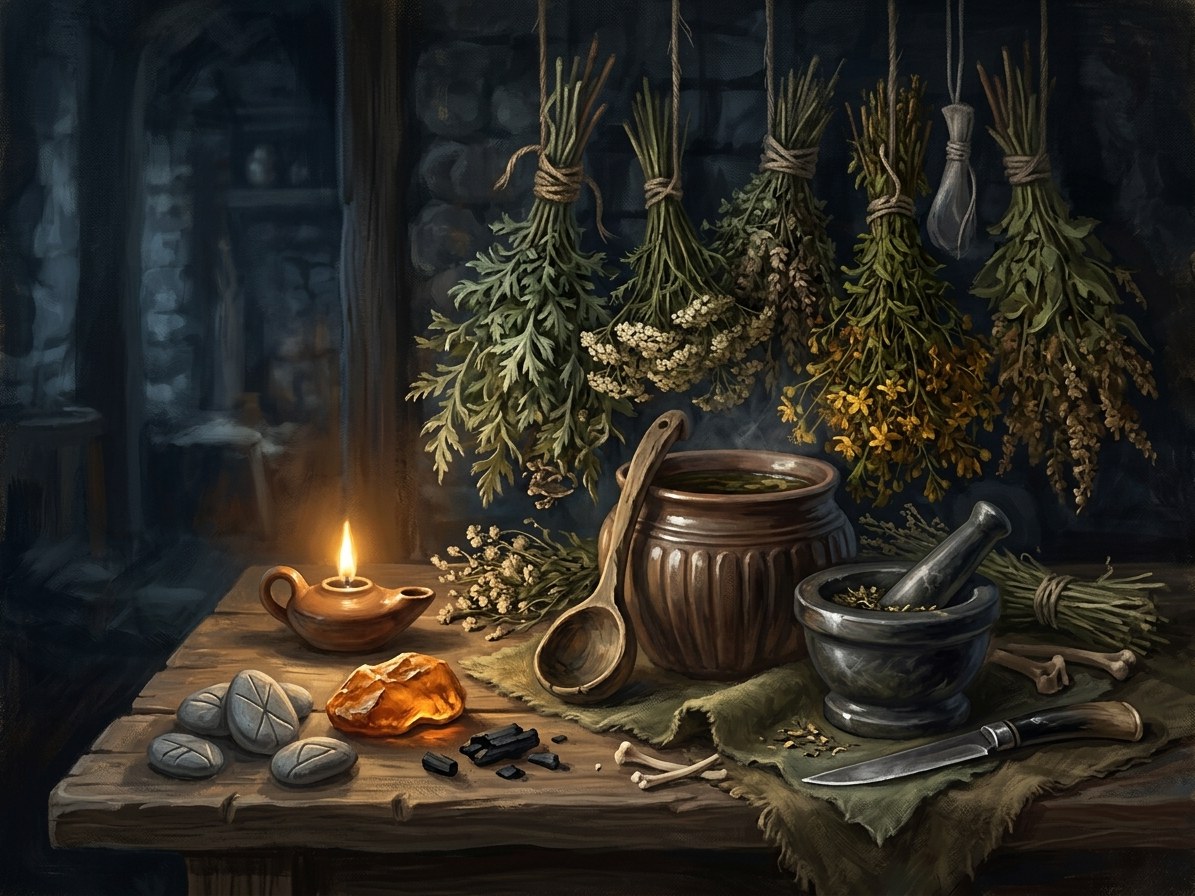
Herb-lore: brews, smokes and poisons. It is power anyone can carry, with no gift and no Law of Balance, which is exactly why it is the most dangerous. It is mundane chemistry in a mythic world.
Žolės (herb-lore)
Žolės (herb-lore) · school
Type |
school |
Family |
asked |
Note |
Žolės: traditional herbal knowledge, brews, healing poultices, and subtle poisons. |
Who can use it (path & tier)
Tier 1: the žolininkė, the herb-woman, the midwife; also anyone who can gather and measure: Ona, the Lagoon witch, the Order’s poisoners. Eglė practises it at tier 3.
How it works (medium, words, timing)
Herbs gathered at Rasos (Midsummer) before dawn, in silence, are double potency and keep a year. Effects: sleep, truth-loosening, fever-breaking, wound-cleaning, and the seer’s smoke (henbane and amber dust) that lets a Kalba seer see further.
Costs
There is no magical cost: the price is the moral one. The seer’s smoke costs a terrible headache. A poison needs no sorcery at all (Book II ch. 16: “no spell, no god, no pact; only henbane seeds and root, a human hand’s work”).
Limits & counters
It is mundane, so it can be undone by mundane means: knowledge, a physician, an antidote. In the saga’s moral design it is where the worst crimes are done, because the horror is how little magic the world needs. A charm plus a Rasos-herb poultice heals what Water cannot.
Folk basis [Historical record]
[Historical record]. Lithuanian folk medicine was rich in wormwood (kietis), St John’s wort (jonažolė), sweet flag (ajeras), mugwort, linden, chamomile, valerian, henbane (drignė) and poppy; herbs gathered on Joninės night were held strongest, and the Assumption (Žolinė, 15 August) is the herb-blessing feast.
Notable practitioners
Ona’s sleeping draught for the guards at Krėva (Book I ch. 12); Ona’s herb list “kietis, chamomile, jonažolė, and drignė, keep that one apart” (Book II ch. 4, 6); the slow poison in the hostage sons’ food, drignė, kietis and sugar (Book II ch. 9); Skirgaila’s death in 1397 (ch. 16). The historical poisoning of 1392 rests on weak evidence (Simon Grunau).
Relations
Practitioners: Eglė (vaidilutė → Pelkių Eglė) — tier 3 · Ona — tier 1
- School
- Asked power in the family list, but no gift and no Law of Balance. Power anyone can carry
- Tier
- Tier 1 · žolininkė, midwife. Eglė practises it at tier 3
- Casting
- Gather, brew, smoke. Rasos herbs are picked on solstice night before dawn, without speaking
- Components
- Wormwood (kietis), St John's wort (jonažolė), sweet flag, mugwort, linden, chamomile, valerian, henbane (drignė), poppy
- Cost
- No magical cost. The seer's smoke costs a terrible headache. The price is moral
- Duration
- Rasos herbs have double potency and keep a year
- Limits
- Mundane: it works as chemistry. Needs no gift, and no gift improves it
- Counters
- Knowledge, a physician, an antidote
What it does. Sleep (Ona's draught), truth-loosening, fever-breaking, wound-cleaning, and the seer's smoke: henbane and amber dust, which lets a Kalba seer see further.
With a charm. A Rasos-herb poultice and a bleeding-charm heal what Water cannot.
Poison. The herb-lore of princes. Skirgaila's death (1397) and the hostage sons' poisoning (1392, a contested tradition from Grunau,) are herb-lore, not sorcery: henbane, kietis and sugar.
No law to break. That is why it is the most dangerous: the horror is how little magic the world needs.
Connections
graph LR
  egle["Eglė (vaidilutė → Pelkių Eglė)"]
  ona["Ona"]
  zoles["Žolės (herb-lore)"]
  egle -->|Practises| zoles
  ona -->|Practises| zoles
  style zoles stroke-width:3px