Geležinis Vilkas (the Iron Wolf omen)¶
Folk source [Historical record]¶
In the legend recorded in the 16th-century Lithuanian chronicles, Grand Duke Gediminas, after hunting near the Šventaragis valley, slept on a hill and dreamt of an iron wolf howling with the voice of a hundred wolves. The pagan priest Lizdeika interpreted it: Gediminas should build a castle and city there, whose fame would carry like that howl. Thus Vilnius was founded.
Geležinis Vilkas (the Iron Wolf omen)
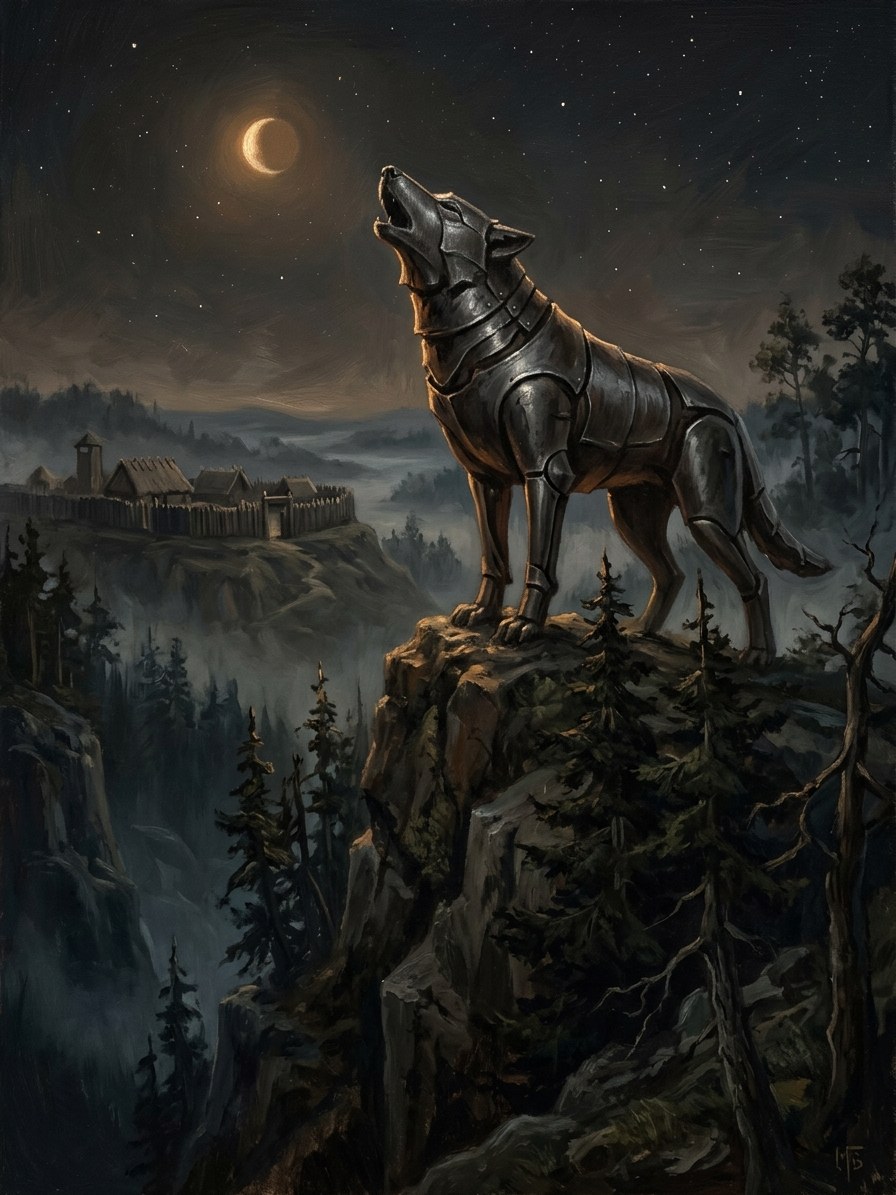
Geležinis Vilkas (the Iron Wolf omen) · creature¶
Tipas |
būtybė |
Status |
Sagos išmonė |
Pastaba |
Bestiary §23. An omen of Gediminid fate; cannot be met or fought. |
In the saga (where the folk are half-wrong)¶
Not a creature that can be met, fought or fed: an omen-entity, the bound spirit of the Gediminaičiai themselves. In the Krivis’s version of the legend it is iron because it is collared, and its hundred voices are the house’s own sons and grandsons tearing at one another. It howls at the turning points of Gediminid fate: a Gediminid betrayed, kneeling at a foreign altar, or dead. The thousands of wolves that answer it (Book I ch. 9) are the dead sworn vilkatai, laid in bogs and never burned. The brotherhood keeps the one physical relic of the dream, the wolf’s skull, on which every initiate swears.
Signs & habitat¶
Thousands of wolves howling at once in the deep forest; a wolf of grey iron glimpsed in mist on an island or hill; frost on iron in summer.
Before / after the Unbinding¶
Before: it howled once in Gediminas’s dream and seldom since. After 1382 it howls often: at the prologue’s prophecy, at Kęstutis’s death (ch. 9) and on through the series. When the last flame dies in 1430 it is seen dissolving into mist on Trakai island (Book V ch. 1), and its last howl rises from the Trakai lake in 1440 (Book V ch. 22).
Banes, wards, bargains, and their cost¶
None. Those who hear it learn their master’s fate, not their own; the cost is knowing.
Danger level¶
Omen (not rated).
Story hooks¶
Book I: the prologue; ch. 9; ch. 25’s rumour (the folk attach the omen to Vytautas, which is half right). Book V: the epilogue’s grandfather, „Kai miškai buvo žali, jis buvo.“
Ryšiai
Anchored by: Geležinio Vilko kaukolė — The one physical relic of Gediminas’s dream.
Servant of: Gediminaičiai (House of Gediminas) — The collared spirit of the house; howls at the turning points of Gediminid fate.
Origin [Historical record] Gediminas's dream, read by Lizdeika (16th-century chronicles) · [The saga's invention] the collared spirit of the Gediminid house
Tier Omen-entity · cannot be met, fought or fed
Danger Omen (not rated)
Habitat The Šventaragis hill, Trakai island and its lake, the deep forest
Wants Nothing. It howls from grief, not hunger
Takes Nothing. It gives knowledge, which is the cost
Signs Thousands of wolves howling at once; a wolf of grey iron glimpsed in mist on an island or hill; frost on iron in summer
Banes None
Half-wrong truth. The folk (and Lizdeika's public reading) say a castle and a famous city. The Krivis's version: iron because collared, and its hundred voices are the house's own sons and grandsons tearing at one another. The folk attach the omen to Vytautas himself, which is half right.
The pack. The wolves that answer it are the dead sworn vilkatai, laid in the bogs and never burned. The brotherhood keeps the one physical relic of the dream, the skull.
Howling. At the turning points of Gediminid fate: a Gediminid betrayed, kneeling at a foreign altar, or dead.
Its end. Seen dissolving into mist on Trakai island when the Last Flame dies (1430). Its last howl rises from the Trakai lake in 1440.
Knowing. Those who hear it learn their master's fate, not their own.
Sąsajos¶
graph LR
  gediminaiciai["Gediminaičiai (House of Gediminas)"]
  gelezinis_vilkas["Geležinis Vilkas (the Iron Wolf omen)"]
  wolf_skull["Geležinio Vilko kaukolė"]
  gelezinis_vilkas -->|Servant of| gediminaiciai
  wolf_skull -->|Anchors| gelezinis_vilkas
  style gelezinis_vilkas stroke-width:3px