Goštautas gives the warm coin to a beggar
What the chronicles say [Historical record]
Nothing in the record. Jonas Goštautas’s Vilnius feast (February 1437) is the saga’s; the Hanseatic loan for the bricks is invention on top of the real Hansa office at Kaunas (c. 1441).
Goštautas gives the warm coin to a beggar
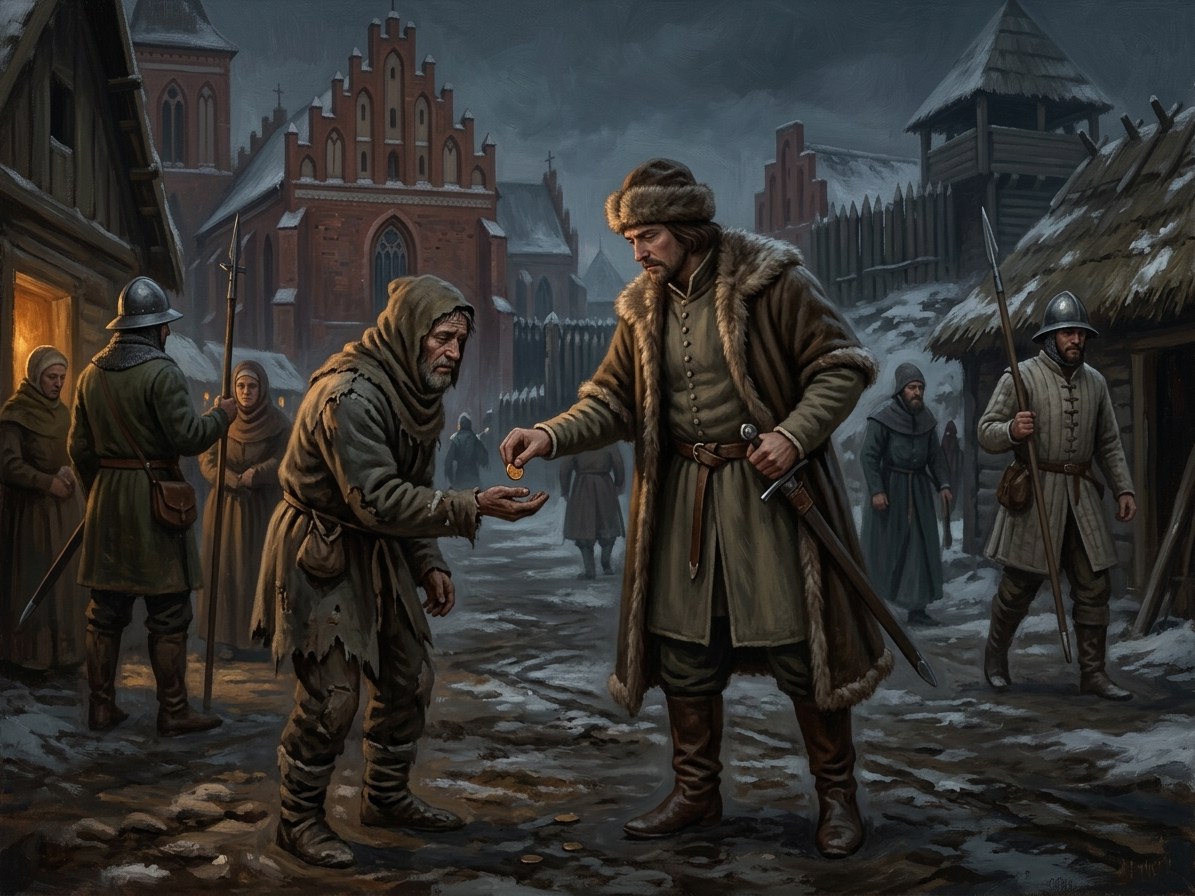
Goštautas gives the warm coin to a beggar · event
Type |
event |
Years |
1437 |
Status |
The saga’s invention |
Book |
|
Chapters |
17 |
Note |
Feb 1437, Vilnius. The Counter: “one coin reached a person”. The beggar is not named; read as Dievas. |
Where: Vilnius (on the map)
What really happened [The saga’s invention]
After the last guest leaves, a warm coin lies by the untouched sugar swan (a coin that warms from someone else, not from a hand). Goštautas gives it to an old beggar on the threshold without looking at it. Under the floor the Counter falls silent for three breaths; then: “Viena moneta pasiekė žmogų. Neįvertinta. Neužskaityta.” The beggar is not named in the text; read as Dievas Senelis, the same Beggar who turned Kęstutis’s coin to stone in 1382. The Counter then reads the term on Trakai: three years and a month.
Consequences
It foreshadows Žygimantas’s murder at Trakai in March 1440.
Dramatisation
Book V ch. 17 “Aukso Rijūno Puota” (Goštautas; February 1437, Vilnius).
Relations
Location: Vilnius
Participants: Dievas (Senelis) — The beggar on the threshold (implied; never named in the text). · Jonas Goštautas
Connections
graph LR
  dievas["Dievas (Senelis)"]
  ev_gostautas_coin["Goštautas gives the warm coin to a beggar"]
  gostautas["Jonas Goštautas"]
  vilnius["Vilnius"]
  ev_gostautas_coin -->|Location| vilnius
  gostautas -->|Took part in| ev_gostautas_coin
  dievas -->|Took part in| ev_gostautas_coin
  style ev_gostautas_coin stroke-width:3px