The “Blur”
Diagnostic Overshadowing
“Diagnostic Overshadowing” is a fancy medical term for “Tunnel Vision.” Once a child has a diagnosis of Autism, everything they do is viewed through that lens. This is a well-documented phenomenon where symptoms of a co-occurring mental illness are misattributed to the developmental disability (Van Meter, Handen, et al. 2018).
Research shows that up to 30% of youth with Bipolar Disorder also meet the criteria for Autism Spectrum Disorder (Joshi et al. 2013). Yet, families often face years of delay before the second diagnosis is made.
Case Study: Alex’s “Burnout”
Alex Miller (14) has been Autistic his whole life. His parents know his rhythms: he needs quiet after school, he loves Minecraft, he hates tags on his shirts. But this winter, something changed. Alex stopped playing Minecraft. He stopped eating. He lay in bed for 18 hours a day, staring at the ceiling. “It’s Autistic Burnout,” the therapist said. “He masked too hard at school. We need to reduce demands.” So they did. They let him stay home. They brought him food. But then, two weeks later, Alex didn’t just “recover.” He ignited. He stayed up for 48 hours straight. He decided he was going to learn Japanese overnight. He became irritable, snapping at his mom for “breathing too loud.” “He’s just dysregulated from the burnout recovery,” the therapist said. The Reality: Alex was cycling. He was in a Bipolar II cycle of deep depression followed by hypomania. But because everyone was looking at “Autism,” they missed the mood disorder for two years.
Rapid Cycling vs. Emotional Dysregulation
Both ADHD and Bipolar involve “Mood Swings.” But they are different shapes.
ADHD: Emotional Dysregulation (The Spike)
- The Shape: Spiky.
- Trigger: Reactive to the environment (e.g., losing a video game, being told “no”).
- Duration: Short. Mood shifts happen multiple times a day.
- Baseline: Returns to baseline quickly once the trigger is gone.
- Example: Leo throws a controller because he lost a game, screams, then 20 minutes later asks what’s for dinner.
Bipolar: Rapid Cycling (The Wave)
- The Shape: Waves.
- Trigger: Often endogenous (internal). Can happen on a perfect day at Disney World.
- Duration: Longer. Even “rapid cycling” usually involves days or weeks in a specific state.
- Baseline: The baseline itself shifts. The “whole person” changes for a week.
- Example: Alex wakes up sad. Nothing bad happens, but he stays sad for 10 days. Then, he wakes up “electric” and stays that way for 4 days.
Visualizing the Difference: Alex’s 30-Day Timeline
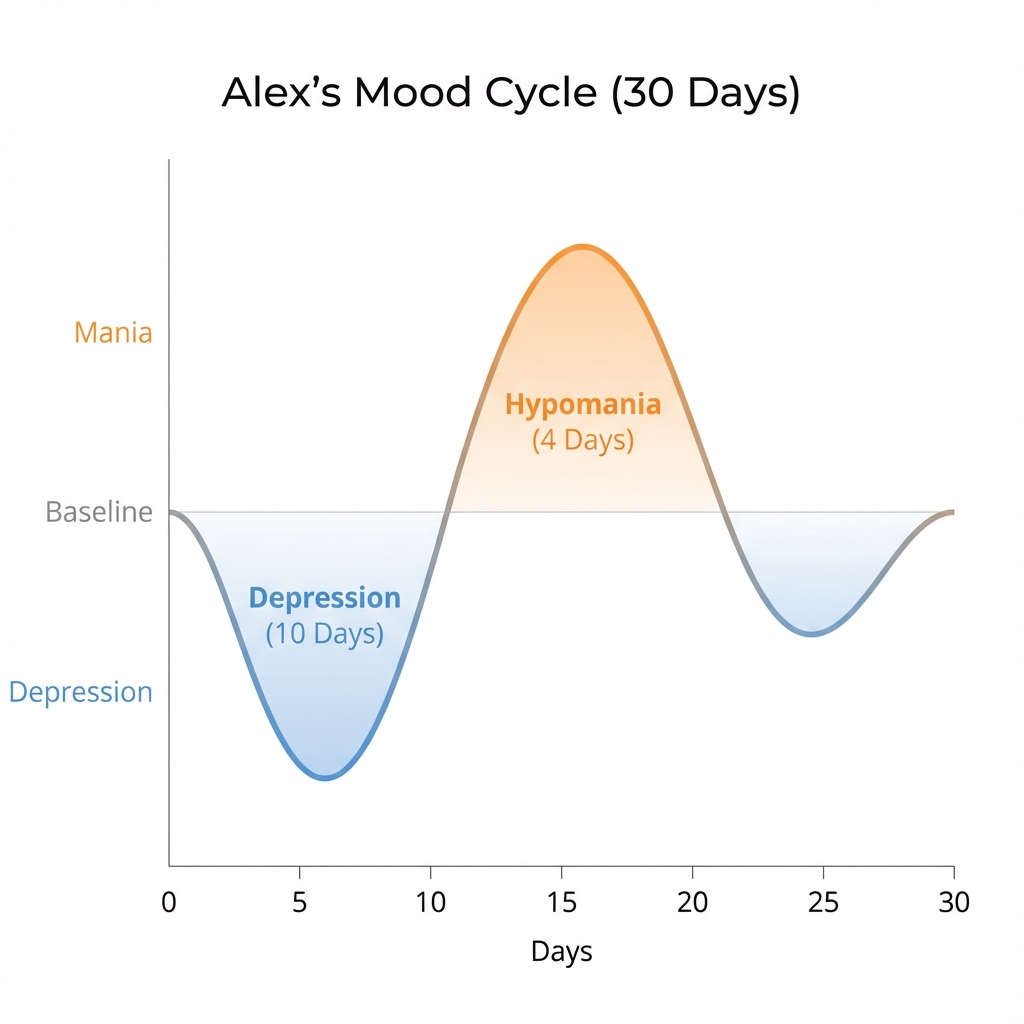
Compare this to an ADHD mood pattern (not shown), which would be dozens of tiny spikes within a single day, triggered by specific events (video game loss, criticism, etc.). Notice how Alex’s Bipolar pattern has sustained states lasting days, not hours.
Protocol: The Timeline Reconstruction Tool
To cut through the blur, you need data. You need to build a timeline.
- Map the “Baseline”: What was your child like at age 7? Age 10? Before the crisis?
- Mark the “Shift”: When did the nature of the meltdowns change? Was there a specific semester where grades dropped or sleep vanished?
- Overlay the Triggers: Did the shift coincide with puberty? A new medication (SSRI/Stimulant)? A viral illness?
- Look for Periodicity: Do the crises happen every Spring? Every October? (Seasonality is a hallmark of Bipolar).
Action Step: Take a blank calendar. Mark the “High Energy” days in Red and the “Low Energy” days in Blue. Do not mark “Good/Bad” days (behavior). Mark Energy. If you see blocks of Red and Blue, you are likely looking at Bipolar, not just ADHD.